Art In The Digital Jungle: On Contemporary Art and Creating Without A Self
No items found.
Words by
Savannah Huitema & Sean Koons
A soulless tech advertisement selling agentic software that no one understands, an influencer brand ambassador wearing sustainable cashmere crafted by tiny hands in an overseas sweatshop, a creative “guru” peddling a glorified gambling app, a large-eared hairless sphynx upset she’s been made to take a bath, an NFL player walking for an Italian fashion house in a skin-pinching leather catsuit. At its worst, modern aesthetic life feels like constantly cutting through the tangled vines of a digital jungle. It’s covered in screens looping disparate clips. But for all their frenzy, these screens know nothing at all.
They’re a factory of false dreams.
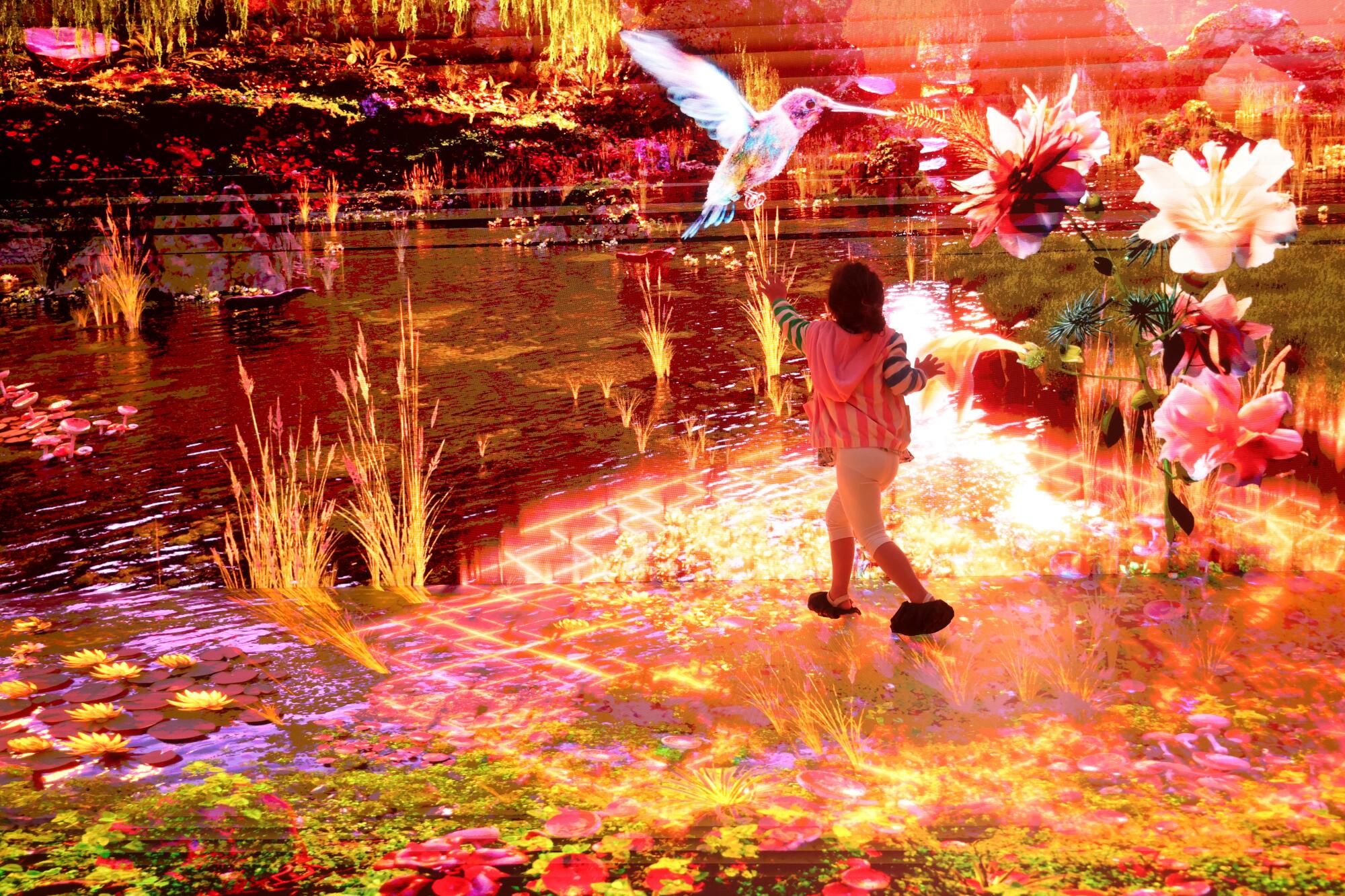
“Machine Dreams: Rainforest.” That’s the name of Refik Anadol’s inaugural exhibition that recently opened in Los Angeles at DATALAND, the world’s first AI art museum.
Guests walk through a computer-created biosphere made up of 1.5 billion pixels. Powering the exhibition is the “Large Nature Model,” a multimodal AI trained on over 500 million images of nature. (Anadol demurs that this data “is ethically and sustainably sourced.”) To enjoy the experience of “Machine Dreams,” one must suspend disbelief and allow the machine to produce the art. One must also refrain from asking questions, like why it’s better to be immersed in an AI-generated rainforest as opposed to saving a real one from being choked by the climate crisis — a crisis which, ironically, is exacerbated by the datacenters that fuel the exhibition.
On Anadol’s website, I learn that the digital forest “offer[s] a sensorial meditation on the mutualistic patterns that shape both technological and biological life.” Incoherent platitudes and AI-cheerleading must be taken to new extremes when one’s patrons include Nvidia’s Jensen Huang and Google (the New Yorker’s Kyle Chayka calls these affiliations “tastewashing” — when tech companies attempt to associate themselves with art and high culture to create an illusion of “coolness” and palatability).
Art hasn’t always felt so uncanny, so purposeless. But this feeling has certainly gotten progressively more irritating in recent years. The technosphere continues to push its way into our aesthetic life. The algorithm, after all, selects for more of itself. And then, as if asleep, we drive this propagation, making and consuming art compatible with an algorithm. Both owing to this capture and to the slew of machine-generated content on our feeds, we’ve learned what creation is like without a self: it’s the proverbial forest of homogenized “slop” in which we wander. So much around us suffers from the eerie quality of authorless sameness, like a Midjourney-generated biosphere. Taste is no longer felt, so it can only be performed. Badly. What we’ve been given is the ability to corrupt the creative act itself.
In his last project at MoMA titled “Unsupervised,” Anadol used a machine learning model to interpret over 200 years of MoMA’s archive to create authorless images in real time. In New York Magazine, art critic Jerry Saltz dismissed it as “a narcotic pudding” that lacked the lived experience necessary to make good art. “Unsupervised” was awash with the sense — call it slop — that the work came from no one.
Visual art is not the only discipline showing signs of the tech vanguard’s colonization. Last month, Demna showed his Resort collection for Gucci in the concrete jungle — Times Square, the center of American commercial life, became a Gucci advertisement ready-made for an influencer’s lens.
Absent was the slow, deep beauty of Italian high culture. Tom Brady walked the runway in a vacuum-sealed jumpsuit. Paris Hilton emerged in a fake wig and a loud, canary yellow dress. AI-generated advertisements for Gucci Hotel, Gucci Pets, and Gucci Life longevity capsules flashed overhead across giant screens.
Everything was algorithmized and obnoxious, an aesthetic now ubiquitous in American life. If all art is communication, this speech emanated from the mouthless void. Or so it seemed.
Demna was poking fun at the ghosts of our age, leaning into the uncanny aesthetic of melting logos and anatomically impossible silhouettes. It was a satirical commentary. As a viewer, the movement of thought began with “this is the hellish logical endpoint of our late-stage techno-capitalist nightmare” and resolved into “this is the landscape now, and we need to find a way to make sense of it." Through brash exaggeration, Demna has acknowledged the problem head on.
The true cost of the thinking machine is that it offers the appearance of arrival without requiring a journey — no one’s journey at all. How can an artist truly know what they believe when they outsource the difficult moments of work to a chatbot, or receive their creative inputs by staring into the infinite abyss of an algorithm? When they create to be legible to that same mindless algorithm?
In the biblical telling, Jacob wrestled through the night with something he could not understand. He refused to release it until it blessed him. By dawn he had a permanent wound, but also a brand new name.
For the ancients to cross into fresh realms, something wasdemanded of the traveler. Blood was a key that unlocked worlds. In Mesoamerica, bloodletting allowed seekers to encounter the “Vision Serpent” — the axis between the human and divine — and open a passage to the spirit world.
Thousands of years later, the motifs remain — of sacrifice, of pilgrimage — in our stories. A price is paid for divine communication, for revelation.
When the artist is at work, she wrestles. She stares at the screen, the empty canvas, or the intertwined threads. Drafts are thrown away. Details are agonized over for days, dripping into dreams.
There is blood in the act. She has been taken into the strange, and is now less strange in her own eyes. The greatest works are traceable to a strong locus of self.
In September of 2021, Peter Do’s debut fashion show took place outdoors in Greenpoint, the sun beginning to set against the Manhattan skyline. Peter chose the location as a tribute to his family’s immigration from Vietnam, and their first view of New York City upon arrival. Backstage, a model’s name was written on a board beside a Polaroid of her face and a simple set of dressing instructions.
Peter’s minimalist restraint was conviction — an unwillingness to permit anything that violated the internal logic of his work. Every silhouette in the collection exuded the elegance of elimination. His mind’s contours were on display: futuristic without self-congratulation, dark without morbidity. Peter was there. The aesthetic was undeniably his.
As an artist, he’d found something deep inside. He’d grappled with the creative process enough to know what moved him, to know what was real. Turned outward, that knowledge was taste.
This is the struggle to know thyself, and to thereby arrive somewhere new.
But when the proofs are mocked up by a fake brain, there’s no wrestling. And when performance is optimized for compatibility with an algorithm, there’s only stagnation. The connection to interior life weakens. All is the unreality of the infinite jungle. It’s not ours.
Artists have been copying (or ripping off) the work of others for centuries. The machine is different. There’s no one’s work to rip off (or, more precisely, the millions of selves whose work the tech companies stole to train their products are wholly diluted in the churn). The thinking machine will never bleed; it has sacrificed nothing. The human still must.
The common cries for a simpler time, a reversal, are well-taken. But if the point of art is to process reality, then the answer cannot be a rejection of reality. It’s not possible to leave the jungle; and yet, something has to give.
Amidst the chaos, the vanguard of the new aesthetic will find who they are. They will refuse to outsource their souls to the thinking machine; they’ll claw their minds from the demand to be legible to an unknowing algorithm, the conformity necessary to sell products on a feed. They will do the hard work of knowing themselves. And it’s up to us to pay attention.
There will be no Anadol-style cheerleading, fetishizing AI for its own sake. These artists will go beyond hyperbolic commentary.
They will reinvent the jungle itself.
When the painting of his day became too ethereal, too unalive, Caravaggio painted his Saints in human form: fingernails dirt-caked, faces gritty, real. Coco Chanel took the corseted suffocation of women’s fashion and pushed the form to transcendence, using traditional men’s fabrics and simple pattern cuts to reimagine the ornate feminine.
Great artists don’t reject reality. They run straight into it and reimagine it in their image.
I compare the memory of when I walked the runway in Peter Do’s debut fashion show with more recent creative presentations. I think about “Machine Dreams” at DATALAND. Worried about distinguishing the human self from the robot, I texted my friend and collaborator, the artist Sean Koons. “Are our dreams just like AI slop?”
He replied that no, they aren’t. “Stop thinking about the data. The new norm will be reinvented. As it always has been.”
Koons pointed to the artist Sougwen Chung. Interested in the evolution of the creative process, Chung paints synchronously with robotic arms, using an EEG headset to sync their brain waves with a machine that’s been trained on two decades of their own work. Last year, they posed a question to the Art Newspaper:
“Where does It end and I begin?”
The tech vanguard wants us to believe their future is inevitable. But artists exist to show us a better norm — a different path through the jungle on this long pilgrimage to revelation, to knowing who we are.